
Tidak ada produk di keranjang.
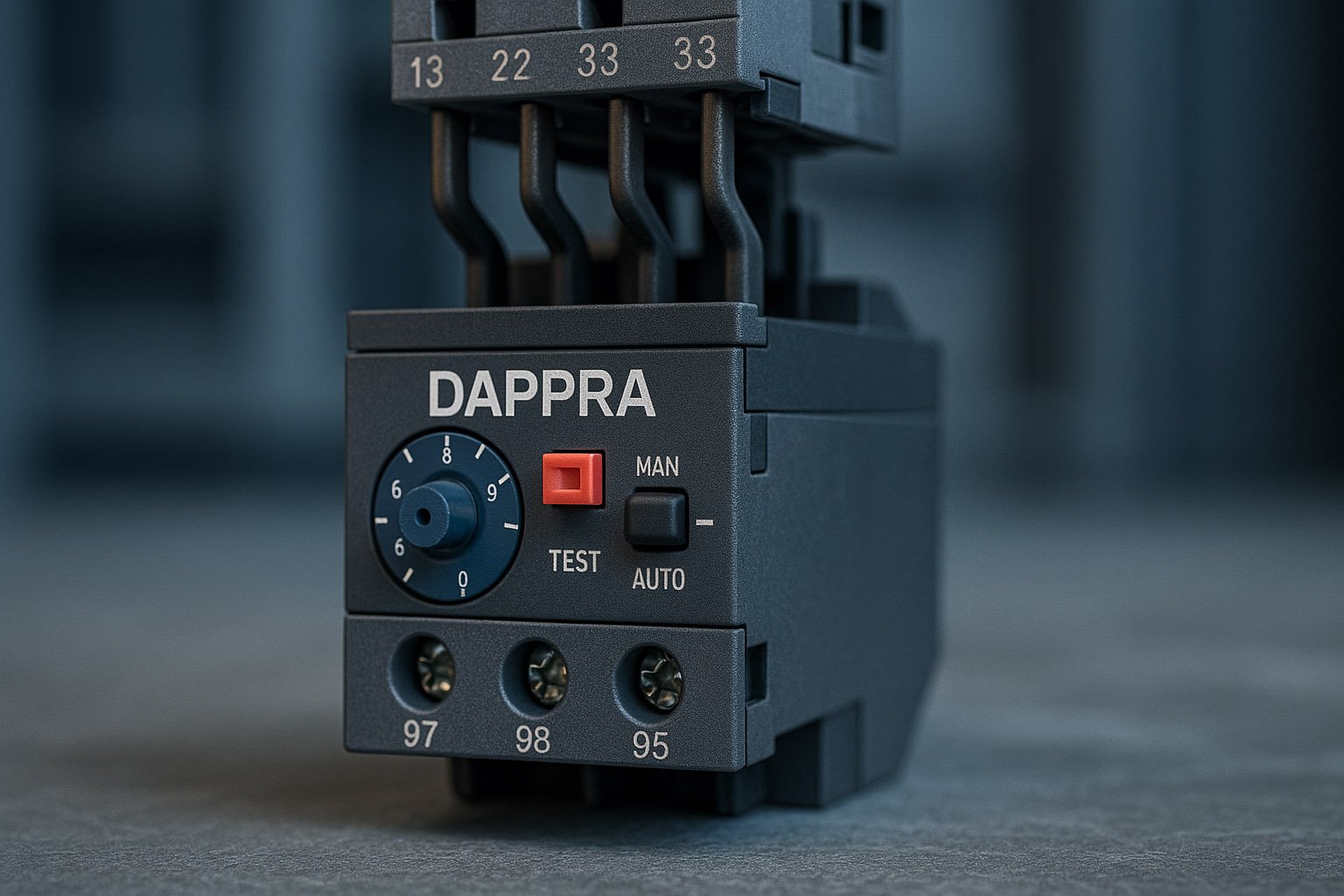
Thermal Overload Relays Explained: Working Principles and Overload Protection Guide
1. Introduction — The Core Device Protecting Industrial Motors
Thermal overload relays are one of the most essential protection components in industrial motor circuits.
They are designed to:
- Prevent motor burnout
- Detect overload and abnormal mechanical load
- Issue alarms or cut off the control loop
Correct understanding and configuration ensure equipment safety and longevity.
2. Working Principles
Thermal overload relays operate based on thermal deformation and delayed response.
2.1 Bimetal Heating Deformation
Inside the relay is a bimetal strip:
- Current increases → temperature rises
- Bimetal bends
- Mechanical mechanism trips the relay
This simulates the heating behavior of the motor.
2.2 Time Delay Characteristics
Overload relays do not trip immediately.
Their thermal delay protects the motor while avoiding false triggering.
2.3 Thermal–Electrical Parameter Relationship
Trip time depends on:
- Motor current
- Ambient temperature
- Bimetal characteristics
- Load profile
3. Circuit Structure
3.1 Installed in Series with Contactor
The thermal relay is mounted under the contactor:
Motor Phase → Contactor → Thermal Relay → Motor
3.2 NC Contact Interrupts Control Loop
The relay has a normally closed (NC) auxiliary contact that opens on trip:
- Stops the contactor coil
- Immediately cuts motor power
3.3 Manual/Automatic Reset
Two reset modes:
- Manual (safe mode)
- Automatic (not recommended unless necessary)
4. Key Parameters
4.1 Ie — Rated Current
Matches motor full-load current.
4.2 Ir — Adjustable Trip Current
Set slightly above working current:
- Typically 1.05× to 1.15× motor current
- Prevents false tripping
4.3 tr — Trip Time
Different protection curves:
- Class 10
- Class 20
- Class 30
Class 10 is most common for motors.
5. Engineering Applications
Thermal relays are used for:
5.1 Motor Start/Stop Protection
Protects from sudden mechanical load changes.
5.2 Mechanical Jamming Detection
Trips when:
- Conveyor is blocked
- Pump is jammed
- Gearbox overload occurs
5.3 Long-Time Full Load Alarm
Detects motor heating during prolonged operation.
6. Common Problems
6.1 Trip Current Set Too Low
Leads to:
- Frequent tripping
- False alarms
6.2 Ambient Temperature Affects Relay Action
High cabinet temperature results in earlier tripping.
6.3 Reset Mechanism Failure
Usually caused by:
- Deformation
- Dirt buildup
- Aged bimetal
7. Best Practices
✔ Adjust Current Based on Motor Nameplate
Accurate calibration ensures proper protection.
✔ Match Thermal Relay with Contactor Model
Avoid mismatch between tripping range and device rating.
✔ Ensure Good Ventilation in the Control Cabinet
Prevents overheating and false tripping.


















Tambah komentar
Anda harus masuk untuk berkomentar.